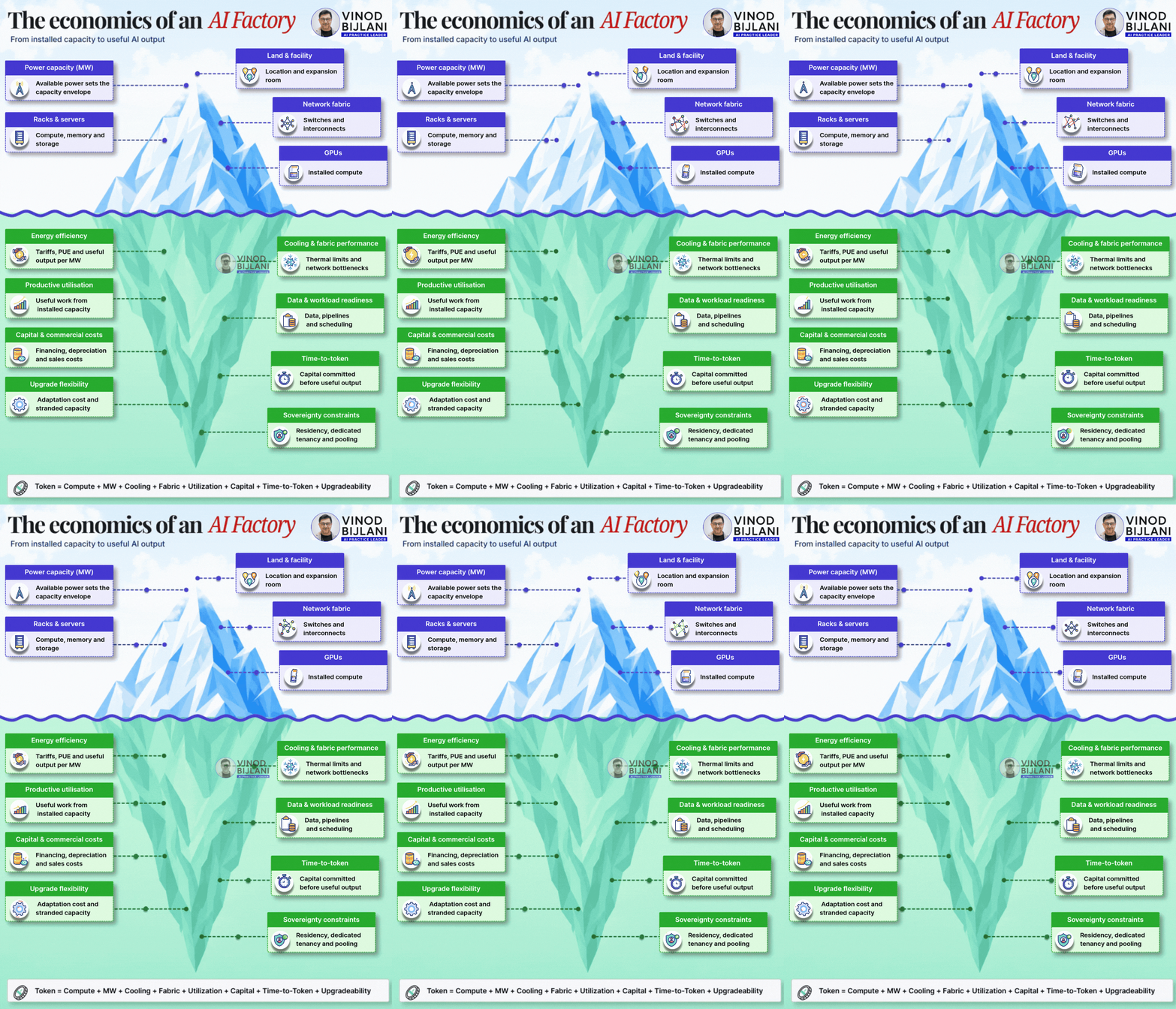
AI data centre economics gets interesting below the waterline. Not because the costs are invisible, but because they scale differently.
A GPU is largely a capital-cost decision. Several other variables compound over the operating life of an AI factory.
Power compounds with PUE and utilisation. A 100 MW IT load at a PUE of 1.2 needs roughly 120 MW at the facility. Improve PUE to 1.1 and you save around 10 MW, continuously. At $0.08 per kWh, that is around $7 million a year from one decimal point.
Cooling economics change with rack density. The question is shifting from "how many racks can I fit?" to "how many kW can I reliably cool per rack?" Moving toward 100 kW+ racks changes facility design, power distribution and cooling all at once.
Network design shows up in GPU economics. An expensive accelerator waiting on data is still consuming capital. Fabric topology, bandwidth and oversubscription show up indirectly in GPU utilisation, and ultimately in cost per token.
Utilisation changes the denominator. A $/GPU-hour number can look attractive while the cluster underneath is poorly utilised. At 40% versus 80% productive utilisation, useful compute costs twice as much.
Staging creates a timing problem. Power may arrive before GPUs. GPUs may arrive before cooling. Buildings may be ready before the grid connection. Every mismatch is capital that has been spent, often debt-funded and accruing interest, without producing a single token.
And then there's the one I think deserves much more attention: stranded capacity. AI hardware generations are moving faster than data centre infrastructure. You can replace GPUs in a few years. Replacing the power envelope, cooling architecture or network topology underneath them is much harder.
So AI factory economics needs to move beyond $/GPU-hour to $/token to $/useful token. The last metric forces us to account for the whole factory: compute, power, cooling, network, utilisation and capital. That's where AI infrastructure design becomes an economics problem.
What would you put below the waterline?