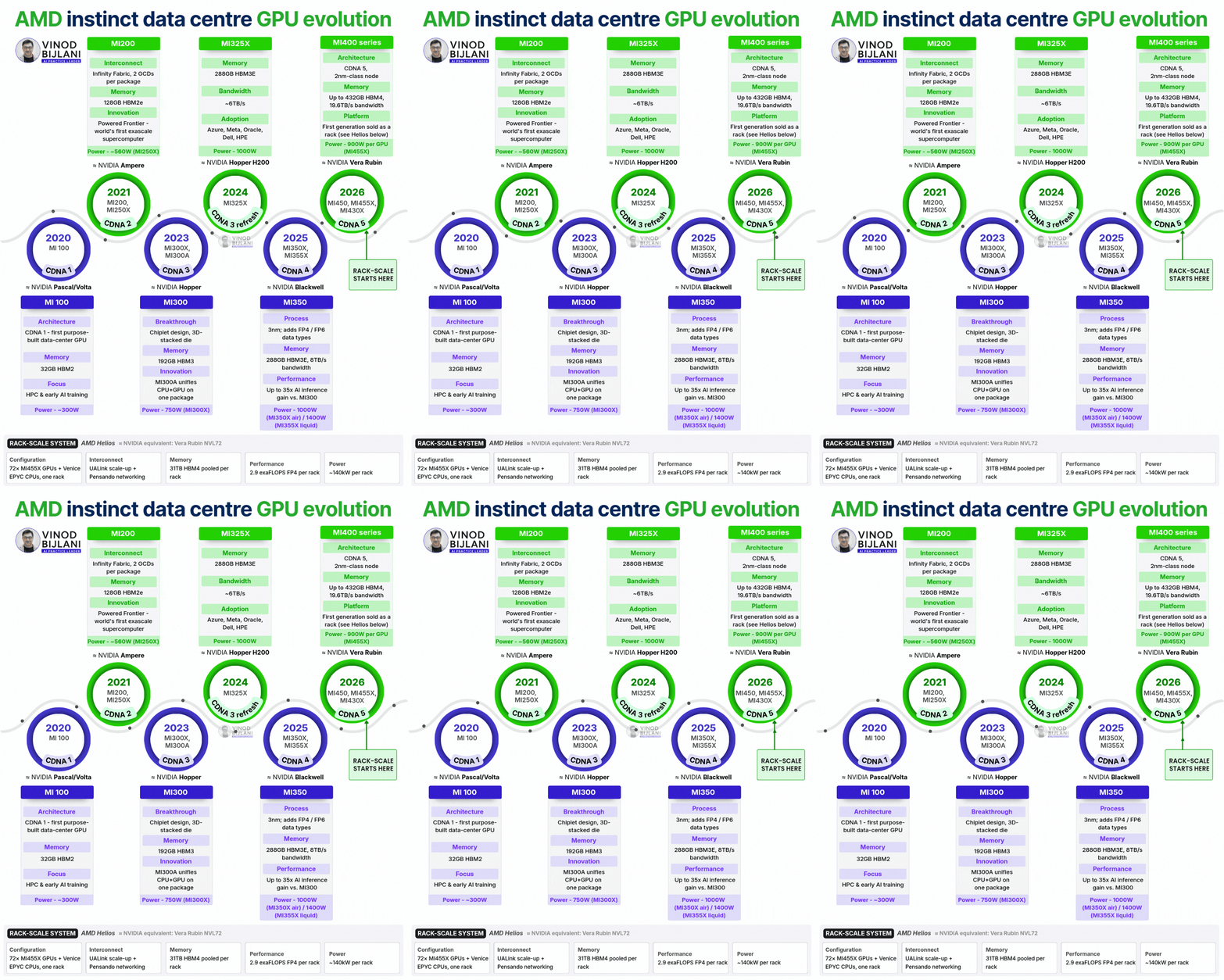
In 2020, AMD's data centre GPU had 32GB of memory. In 2026, AMD has 31TB in a single rack. That jump says a lot about where AI infrastructure is heading.
AMD Instinct in six years:
- 2020: MI100 introduces CDNA for data centre compute.
- 2021: MI200 takes AMD into exascale HPC.
- 2023: MI300 brings chiplets, 3D packaging and up to 192GB of HBM.
- 2024: MI325X pushes memory to 256GB of HBM3E.
- 2025: MI350 and MI355X move to CDNA 4 and add FP4 and FP6.
- 2026: MI400 moves into the rack-scale era.
That last step is the interesting one. With Helios, AMD brings together 72 MI455X GPUs, 31TB of HBM4, EPYC CPUs, Pensando networking, a scale-up interconnect and ROCm in one rack-scale system.
The progression is clear: GPU → node → rack → AI factory.
The accelerator still matters. But increasingly, the system around it matters just as much: memory, interconnect, networking, power, cooling and software.
NVIDIA established much of the blueprint for modern accelerated computing. AMD is now building a serious alternative across the AI infrastructure stack. For enterprises, neoclouds and service providers, that means more choice across architecture, supply and economics, and a much more interesting GPU market.