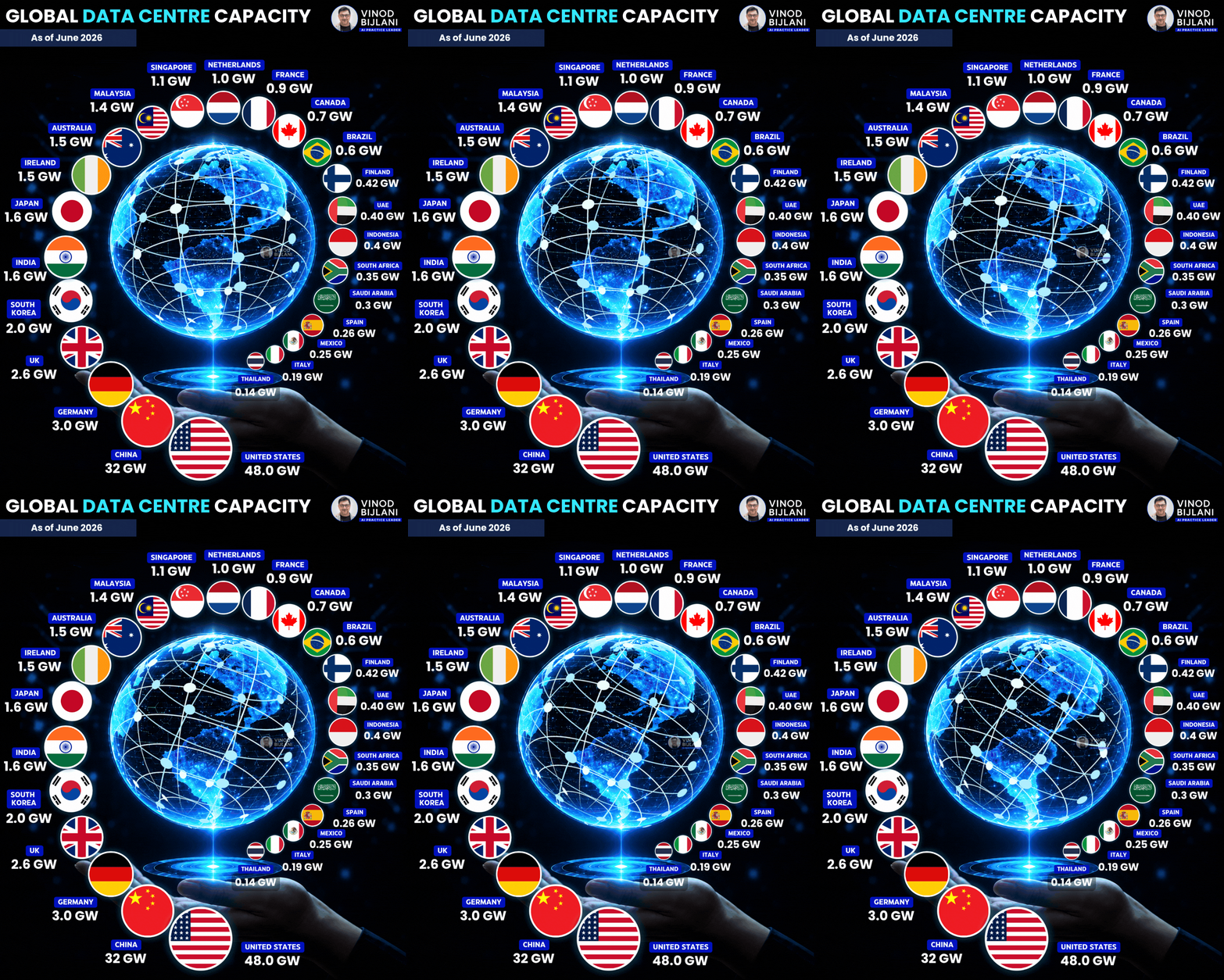
This is the global data centre capacity view I wish I had when I started looking at the AI infrastructure race. It brings together estimated operational capacity across 20 major markets as of June 2026.
A few things stand out immediately. The United States and China dominate the global picture. Europe has significant capacity distributed across several markets. Australia already compares with several much larger economies. Malaysia and Singapore are strengthening Southeast Asia's position. And India has meaningful existing capacity and significant room to scale.
But who actually controls this capacity? It is spread across hyperscalers, neocloud providers, colocation operators and self-hosted enterprise or government infrastructure. Each plays a different role in the AI ecosystem:
- Hyperscalers provide global scale and broad cloud services.
- Neoclouds are building AI-optimised platforms around GPU access, performance and flexible consumption.
- Colocation providers supply the power, cooling and physical environments that high-density deployments need.
- Self-hosted clusters offer greater control over data, infrastructure and AI operations.
The AI infrastructure race is therefore not simply about which country or provider has the most capacity. It is about who can convert that capacity into useful AI compute, with strong GPU utilisation, network performance, deployment speed and economics.
The winners may not be those with the most GPUs. They may be those that generate the most value from every megawatt.