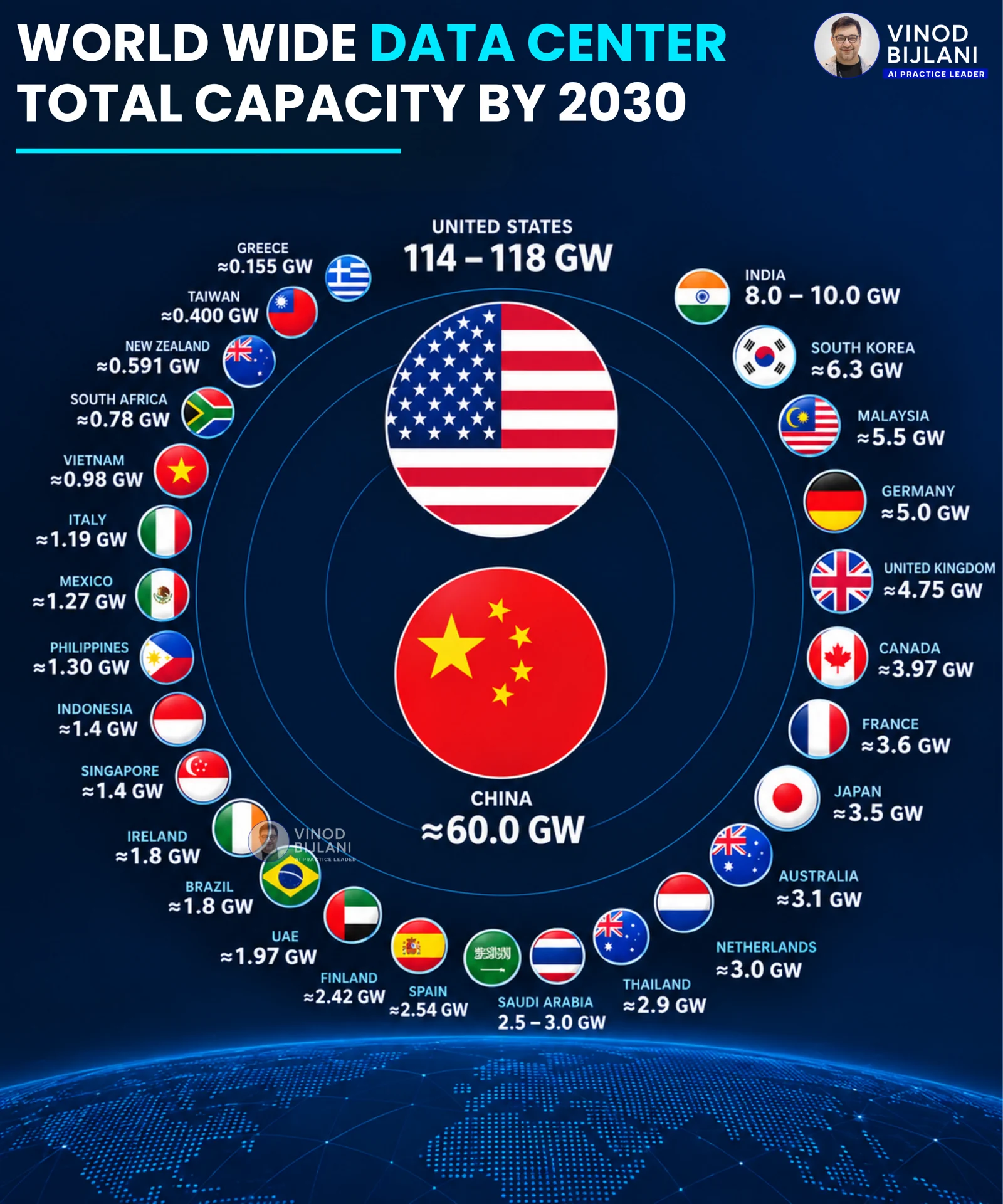
Nearly 250 GW of data centre capacity across 29 markets by 2030. But capacity is only the headline. Power, economics and value per megawatt will determine how much becomes productive AI compute.
A few weeks ago I mapped where the world's data centre capacity sits today. Now I have mapped what the same landscape could look like by 2030. The geography of global compute is being redrawn.
The United States and China will remain the two largest markets. The US moves from about 48 GW today to 114 to 118 GW by 2030; China from about 32 GW to around 60 GW. But some of the most interesting shifts are happening elsewhere:
- India: 1.6 GW to 8–10 GW
- South Korea: 2 GW to about 6.3 GW
- Malaysia: 1.4 GW to about 5.5 GW
- Germany: 3 GW to about 5 GW
- United Kingdom: 2.6 GW to about 4.75 GW
- Australia: 1.5 GW to about 3.1 GW
- Thailand: 0.14 GW to about 2.9 GW
These are not simply data centre expansion numbers. They show where nations, hyperscalers, neoclouds and infrastructure providers expect cloud and AI demand to develop.
First, capacity remains highly concentrated. The United States and China could together account for about 175 GW, nearly 70% of the capacity across these markets.
Second, Asia's footprint is broadening. India, Malaysia, South Korea, Thailand and the Philippines are becoming much more significant parts of the regional landscape.
Third, announced capacity is not operational capacity. Land and capital matter, but grid access, firm power, cooling, connectivity and construction timelines will decide how much of the pipeline is delivered.
And then the question I keep returning to: how much of this capacity will become productive AI compute? That depends on GPU utilisation, network performance, deployment speed, data readiness, security, governance and the economics of every token generated.
The real measure of the 2030 buildout will not be capacity alone. It will be how much trusted intelligence and business value we create from every megawatt.