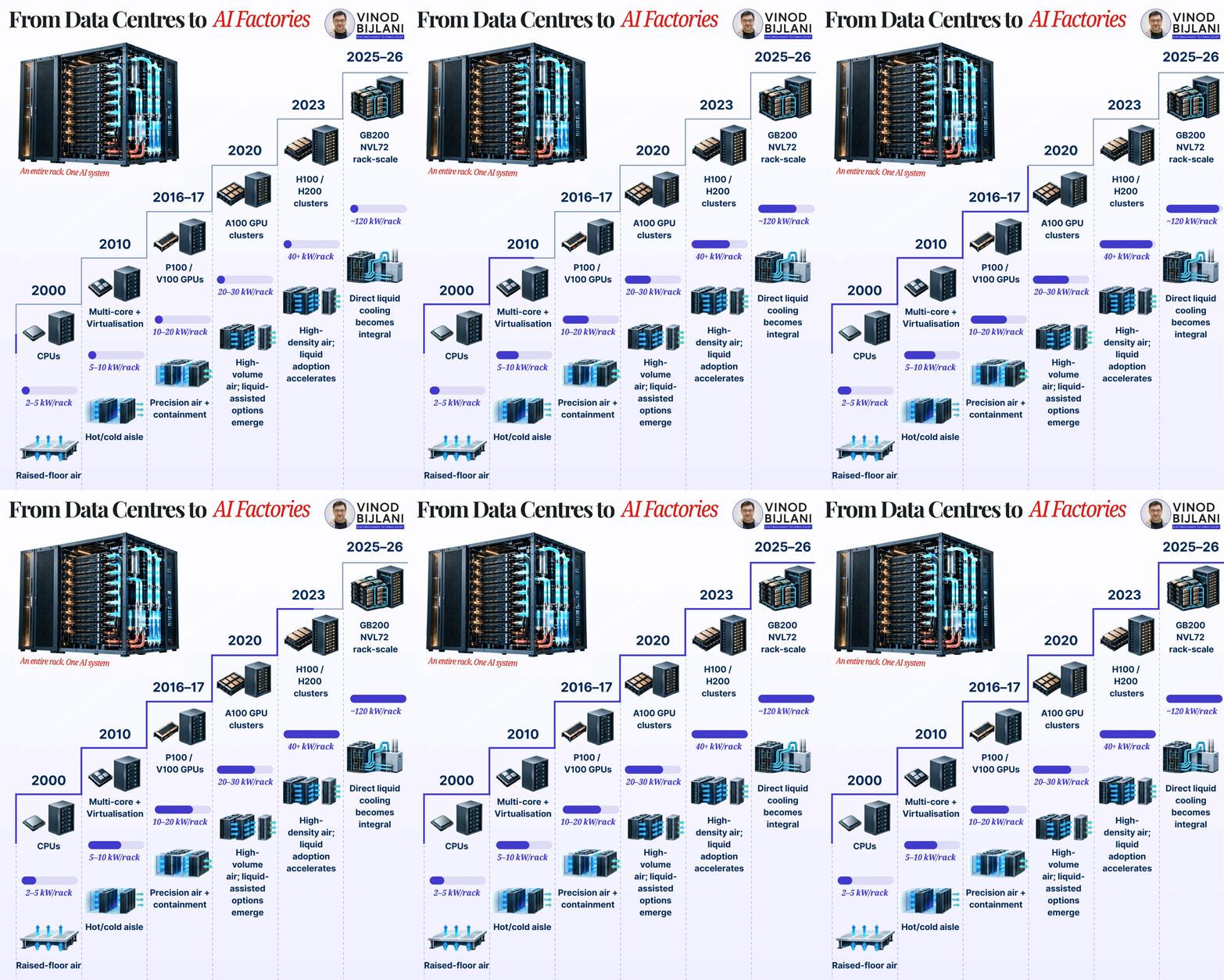
From a few kilowatts per rack to around 120 kW. A similar patch of floor. A very different demand on the building. That is the evolution from data centres to AI factories: from individual servers to entire racks working as one computer.
For years, data centres stored information and ran applications. Banking transactions. Websites. Email. AI adds a different kind of work: training models and generating answers, images and code. Behind that work are GPUs working together and exchanging enormous amounts of data.
Rack-scale AI brings these chips together with fast connections, engineered as an integrated system. But concentrating compute also concentrates its demand for electricity and the heat it produces. A rack drawing 120 kW turns almost all of that power into heat that must be removed. Now multiply that across a room.
This changes the power distribution, backup power and cooling the facility needs, and that is where the cooling story gets interesting. We started by moving cold air through rooms. Then we got better at directing it through racks. Now, in dense AI systems, we bring liquid cooling directly to the hottest chips.
Why liquid? Because it carries heat away far more effectively than air. In direct-to-chip cooling, liquid flows through sealed cold plates attached to the processors and absorbs heat without touching the electronics.
Not every AI deployment needs this level of infrastructure. But at high densities, adding GPUs can mean rethinking the facility around them. Power, cooling and networking must be designed together to keep those GPUs productive.
The "factory" idea makes sense to me here. Electricity and data go in. Useful AI output comes out. How efficiently that happens depends on the whole system.
The chips get the headlines. The infrastructure makes AI at scale possible.