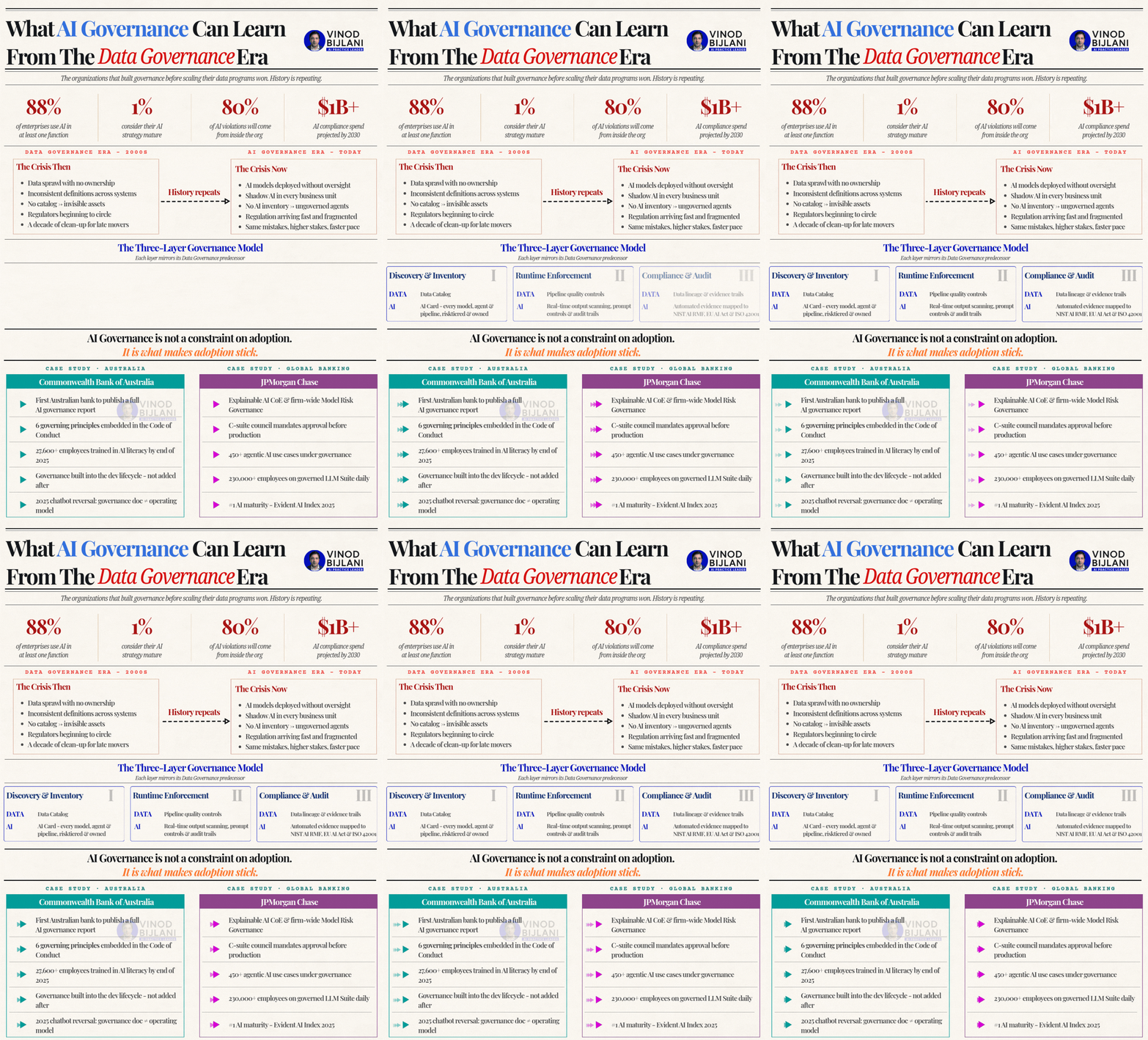
The organisations that built governance before scaling their data programmes won. History is repeating.
In the 2000s the data governance crisis looked like this: data sprawl with no ownership, inconsistent definitions across systems, no catalogue so assets stayed invisible, regulators beginning to circle, and a decade of clean-up for the late movers.
The AI governance crisis today looks familiar: models deployed without oversight, shadow AI in every business unit, no AI inventory so agents go ungoverned, and regulation arriving fast and fragmented. The same mistakes, with higher stakes and at a faster pace.
The answer is a three-layer governance model in which each layer mirrors its data governance predecessor.
Two organisations show what this looks like in practice. Commonwealth Bank of Australia was the first Australian bank to publish a full AI governance report, embedded six governing principles in its Code of Conduct, and built governance into the development lifecycle rather than adding it afterwards. JPMorgan Chase runs an explainable AI centre of excellence with firm-wide model risk governance, and a C-suite council approves AI before it reaches production.
AI governance is not a constraint on adoption. It is what makes adoption stick. I explore this further in my Forbes Technology Council article.