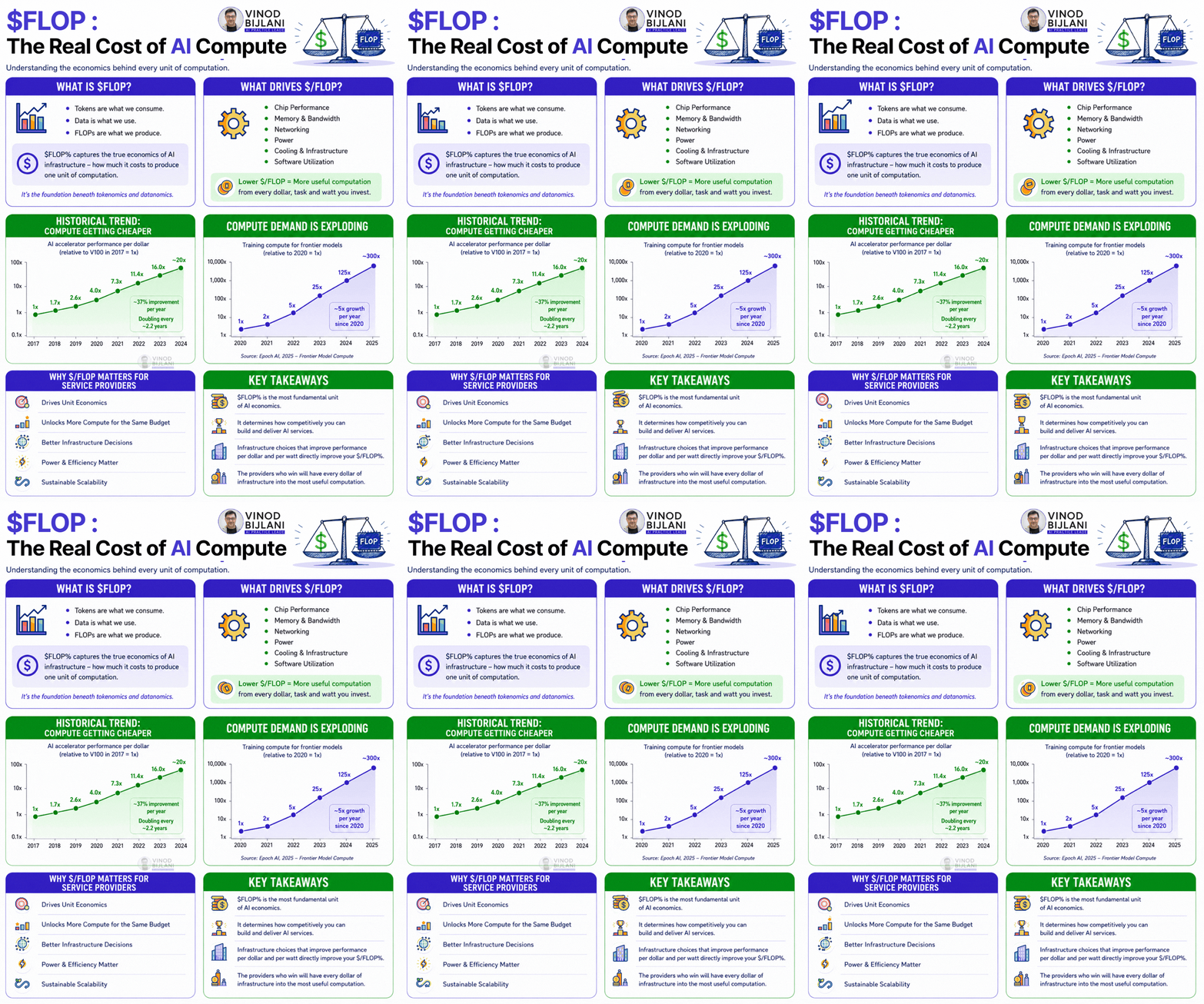
Every AI token has a hidden factory behind it. Most AI cost conversations begin with price per million tokens. It is an important metric. But it tells us what the application consumes, not how efficiently the underlying infrastructure produces it. That requires another lens: $/FLOP.
A cheaper accelerator does not automatically create cheaper AI. The system may still be held back by low GPU utilisation, memory bandwidth, network congestion, storage delays, power and cooling, or orchestration overhead. This is why peak FLOPs and delivered FLOPs are very different measures.
I see three distinct layers of AI economics:
- Tokenomics measures the cost of consuming AI.
- Datanomics measures the cost of making data usable, governed and trusted.
- $/FLOP measures how efficiently infrastructure converts capital, power and physical capacity into computation.
None replaces the others. Together, they reveal where AI costs are really being created, hidden or shifted across the stack.
In my Forbes Technology Council article I explore why infrastructure productivity must become part of the enterprise AI economics conversation. The organisations that scale AI successfully may not have the largest compute estates or the lowest advertised token prices. They will be the ones extracting the most useful computation from every dollar, watt and rack.
Are you measuring the price of AI consumption, or the productivity of the infrastructure beneath it?